An AI Workflow Control Room
A product concept for teams that need to see what their AI workflows did, pause consequential actions, and improve the next run.
Explore this idea ↗Some names describe a feature. Systematically.com describes a standard for how the work gets done.


Cambridge defines “systematically” as doing something according to an agreed method or organized plan. That familiar meaning gives the domain immediate relevance for products and companies concerned with execution: workflow software, AI orchestration, operational consulting, planning tools, quality systems, and other businesses that help people turn intent into dependable practice.
The name arrives with a built-in point of view. It suggests that important work should be visible, considered, and repeatable. A buyer would still have room to decide what that promise means in the product. The brand could lead with control and accountability, with calm personal planning, or with hands-on operating design. It does not force the company into a single feature or a passing technology label.
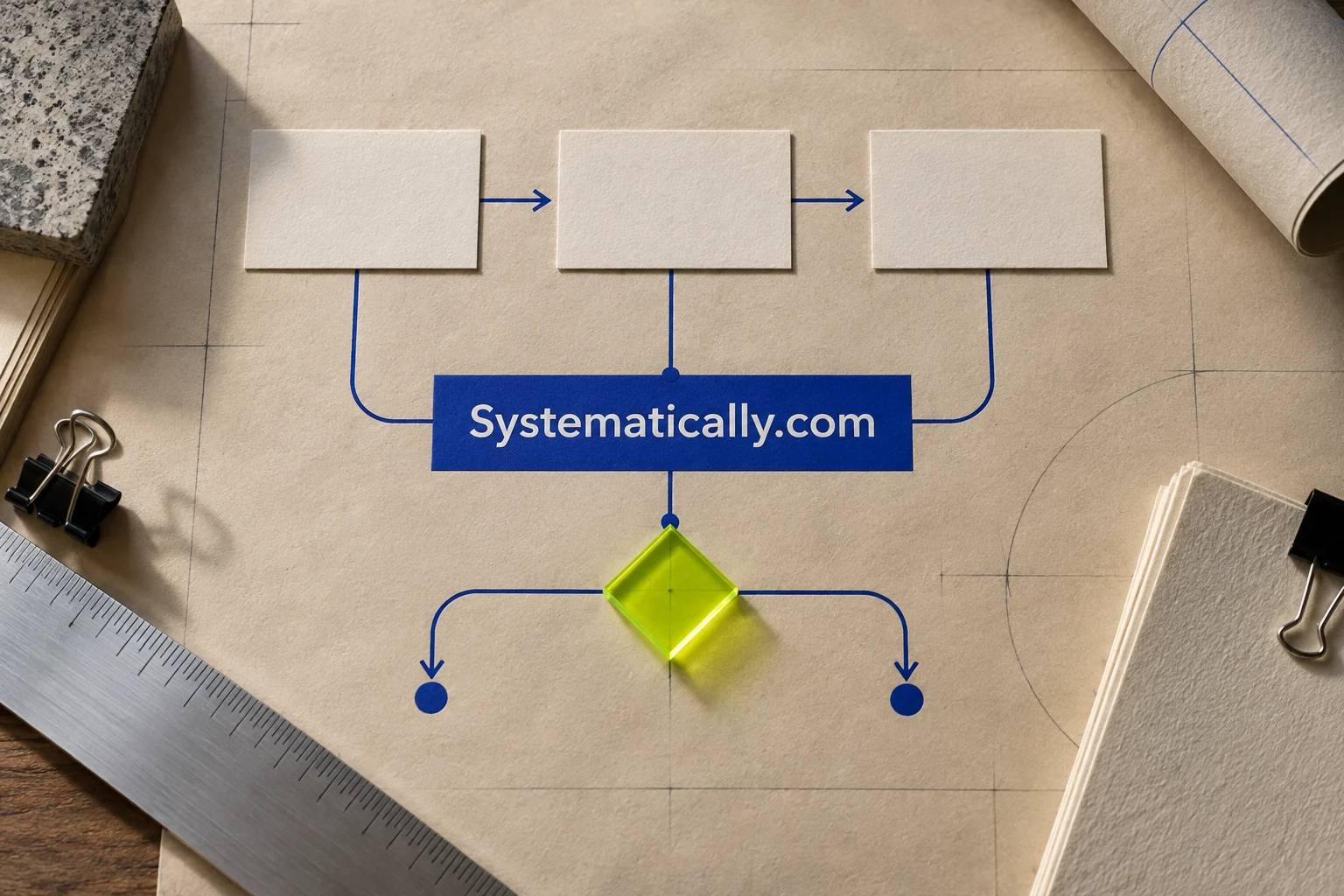
Systematically.com fits where plans meet real work. For a software company, that could mean a control room for multi-step automations, complete with run histories, approvals, exceptions, and clear ownership. For a consultancy, it could frame an offer that maps handoffs and turns recurring work into operating playbooks. For a professional planning product, it could organize priorities around weekly capacity, review, and reset.
Those are different businesses, but each makes a clear promise: the product helps customers work with more structure. The domain can carry that idea before a visitor studies a feature list or sales deck.
The full .com also works well in spoken introductions and written calls to action. It reads as a natural adverb, so it can complete useful brand lines without sounding like an invented software label. “Plan systematically,” “scale systematically,” and “review systematically” each point to a concrete activity. The identity can be direct and editorial rather than dressed up with a complicated explanation.
The best use will come from a buyer with a specific customer and a disciplined first offer. The domain supplies a coherent umbrella, not a substitute for product judgment. It can support technical depth without becoming cold, and it can support a practical service without sounding like a temporary campaign name.
Systematically.com may be especially useful for a team whose current name is too narrow for its roadmap, too abstract for a category conversation, or too hard to explain aloud. An exact English .com can make the introduction simpler while leaving the positioning work where it belongs: in the offer, the proof, and the customer experience.

A B2B platform could help teams design, observe, and improve agent workflows. Instead of presenting another general chat box, the product could show what ran, where a human decision is waiting, which tool produced an exception, and how the next run changed. Explore the control-room concept.
A service business could work with growing teams on the expensive gaps between roles. Its deliverables might include a current-state map, agreed decision rights, a tested playbook, and a small set of measures that expose drift. See the studio model.
A consumer or prosumer product could help people plan against actual capacity, connect recurring work to useful cues, and recover from an interrupted week. The center of the product would be a weekly loop, not an endless backlog. Consider the weekly app.
A product concept for teams that need to see what their AI workflows did, pause consequential actions, and improve the next run.
Explore this idea ↗A focused consulting model for turning one costly recurring handoff into clear roles, tested decisions, and a playbook people can use.
Explore this idea ↗A planning product centered on capacity, useful cues, and a weekly reset rather than another bottomless task list.
Explore this idea ↗Methods for making recurring work clearer, and human decisions easier to place.
A practical method for turning one recurring task into a concise guide with clear triggers, decisions, exceptions, ownership, and a real-world test.
Read the article ↗A risk-based checkpoint map for deciding when an AI-assisted workflow can continue, when a person should review, and when the system must stop.
Read the article ↗The opportunity includes the Systematically.com domain name and the supporting site assets shown here, subject to the final acquisition agreement. The next step is a private inquiry with enough context to understand the intended use and discuss pricing, transfer, and transaction fit.