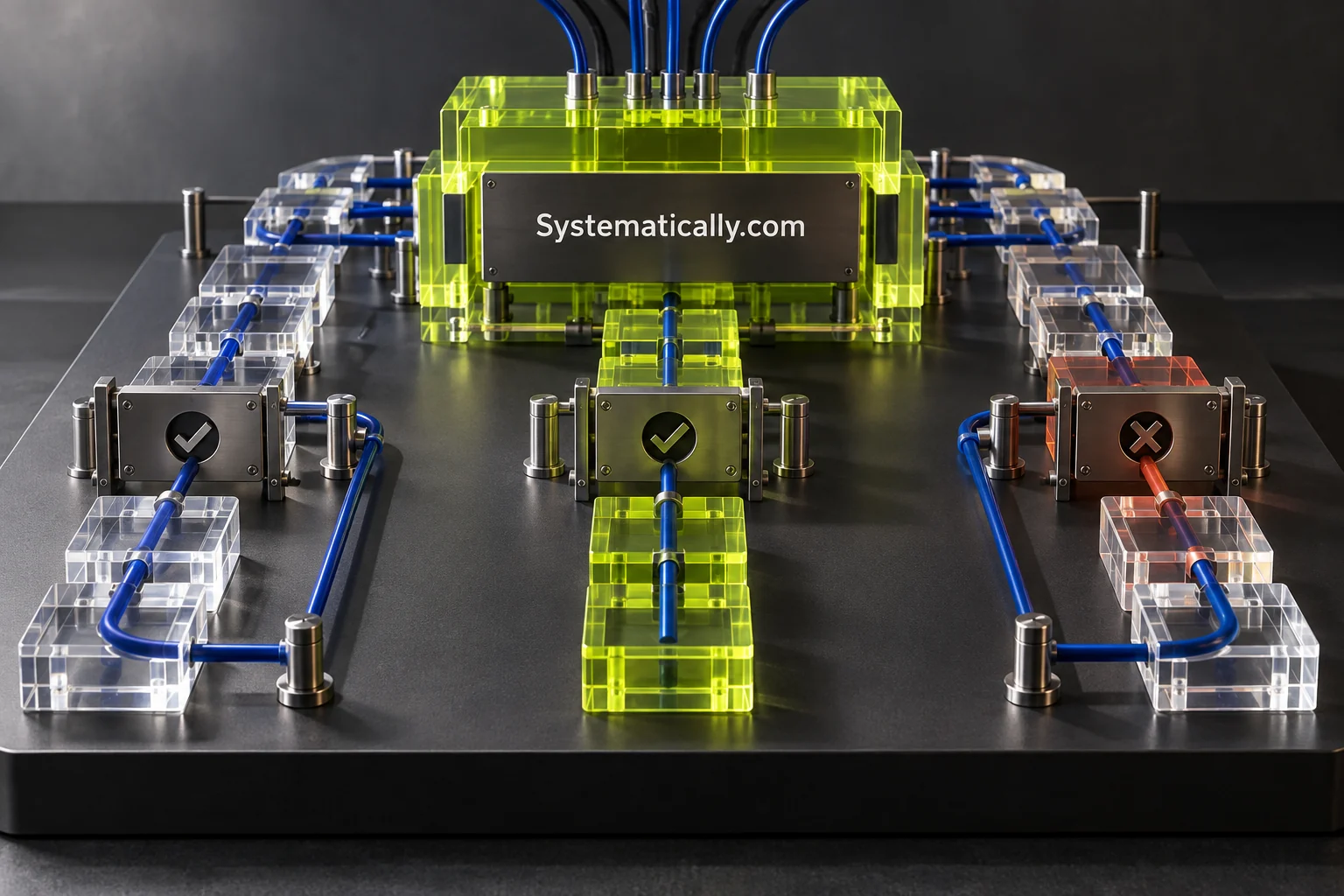
Concept note: this is an illustrative business direction for a future buyer of Systematically.com, not a description of a live product.
AI teams are quickly moving beyond a single prompt and response. Useful systems retrieve information, call tools, hand work between specialized agents, wait for outside events, and sometimes take actions that affect customers. Once a workflow has several steps, the hard question changes. It is no longer only “Did the model produce a good answer?” It becomes “What happened during this run, who was responsible for each decision, and what should happen when the path breaks?”
That is the opening for a product called Systematically.com: a control room for designing, running, and improving AI workflows without hiding the consequential parts behind a cheerful chat interface.
The buyer and the first problem
The first buyer could be a product or operations team with three to ten recurring AI-assisted workflows already in use. Examples include sorting support requests, preparing a response for review, enriching a sales record, assembling a research brief, or checking documents before a human decision.
These teams do not necessarily need another model provider or an all-purpose automation canvas. They need a clear operating view across the tools they already use. A useful first offer could answer five practical questions for every run:
- What triggered the workflow?
- Which steps ran, with which inputs and tool calls?
- Where is a human decision required?
- What failed, timed out, or produced an uncertain result?
- What changed between this version and the previous one?
The product would be less like a chatbot and more like an air-traffic board for work moving through a system.
What the first version could include
The initial product does not need to build every workflow itself. It could sit above an existing orchestration layer and concentrate on control.
A workflow registry would list each approved workflow, its owner, current version, trigger, intended outcome, and permitted tools. A run timeline would show the ordered events for one execution, including model calls, handoffs, tool use, approvals, and retries. An approval inbox would collect decisions that genuinely require a person rather than making someone hunt through email or logs. An exception lane would separate failed, uncertain, and policy-blocked runs. A change record would show which prompt, policy, tool, or model version changed before performance moved.
Current official product patterns show that these controls are technically plausible. The OpenAI Agents SDK human-in-the-loop guide describes runs that pause for approval and later resume from saved state. Its tracing documentation records model generations, tool calls, handoffs, guardrails, and custom events. Systematically.com could turn those underlying patterns into an operations product for people who need a shared, readable view.
A worked example: a refund request
Consider an online service that uses an AI-assisted workflow to prepare refund decisions. A request enters from the support queue. The workflow retrieves the order, checks the stated reason against policy, summarizes the account history, and drafts a recommendation.
Low-risk requests within a small, predefined amount might route to a support specialist for a quick confirmation. Requests above that amount, requests involving repeated claims, or records with missing information would go to a different review lane. The system would never describe a recommendation as a completed refund before the authorized tool actually ran.
In the control room, the reviewer would see the proposed action, the relevant evidence, the policy version, and the exact tool waiting for approval. Approval would release that tool call. Rejection would require a short reason and return the case to a named queue. If the tool timed out after approval, the run would stop in an “outcome unknown” state instead of blindly trying again and risking a duplicate refund.
That example exposes the product’s real value. The model output is only one event. The operating product manages state, authority, recovery, and accountability around it.
Put human checks where the risk changes
“Human in the loop” is too vague to design from. Some steps need no manual review. Others should pause every time. The decision can be based on external impact, reversibility, uncertainty, sensitivity, and the authority required to act.
The NIST AI Risk Management Framework calls for defined human oversight responsibilities and includes post-deployment monitoring, override, incident response, recovery, and change management. The companion Generative AI Profile adds suggested actions for incident ownership, independent evaluation, and alerts that lead to human intervention. These are useful design prompts, not a certification badge.
Systematically.com could help a team turn that guidance into a checkpoint map. A workflow owner would mark actions that publish externally, spend money, change a customer record, expose sensitive data, or create a hard-to-reverse result. Each marked step would need a named decision rule: approve, reject, request more information, or escalate.
Start distribution in one operating context
A sensible route to market would focus on a narrow environment where workflows repeat and tool actions matter. Customer support operations are one candidate because queues, policies, escalations, and external actions already exist. Content operations, sales operations, and internal IT requests offer other plausible wedges.
The company could publish instrumented example workflows for one stack, provide a small integration kit, and invite design partners to bring one production process. A useful demonstration would show a failed run, an approval, and a recovery, not only the happy path. That makes the product’s control value visible.
Early sales could target the person who owns the process and the technical lead who owns the implementation. Both have to see the benefit. Operations needs a readable view and clear responsibility. Engineering needs trustworthy event data, access controls, and a system that does not interfere with the underlying runtime.
What execution would require
This product would handle sensitive operational data, so permissions and retention cannot be deferred. Teams would need control over who can view inputs, who can approve actions, how long run details are stored, and which fields are redacted. Approval screens would need to authenticate and authorize the reviewer rather than treating possession of a link as permission.
The product would also need a careful language for status. “Completed,” “failed,” “waiting,” and “outcome unknown” should mean different things. Retries should be explicit. Version history should connect a change to later runs without implying that correlation proves the cause.
Finally, the company would need a disciplined evaluation practice of its own. It should test workflow behavior against representative cases, record incidents, and make rollback possible. A control room that cannot account for its own changes would weaken the promise of the name.
The smallest useful next step
Before building a broad platform, sketch three workflows in one operating context. For each, list the trigger, steps, permitted tools, owner, external effects, failure states, and human checkpoints. Then draw the run timeline that an operator would need when something goes wrong at 4:30 on a Friday.
If those three views share a common structure, there may be a real product underneath them. Systematically.com would give that product a name that says exactly what it is trying to make possible: complex work carried out through an explicit, improvable method.